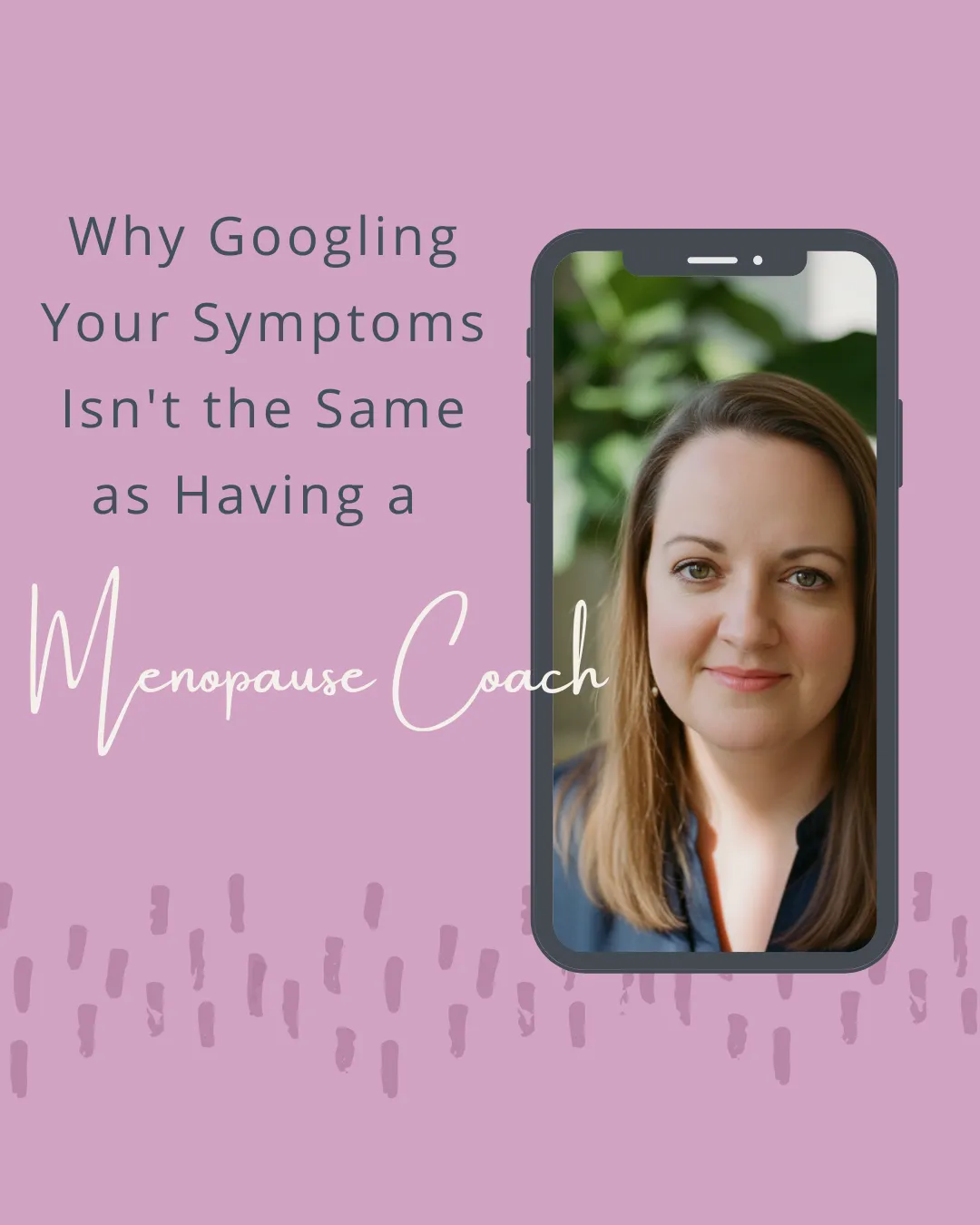
Why Googling Your Symptoms Isn't the Same as Having a Menopause Coach
Let’s be honest.
If you’ve ever typed “Why am I so tired?” into Google, you probably ended up with 17 possible diagnoses, three supplement recommendations, a Reddit thread from 2019, and someone insisting that drinking celery juice at sunrise will fix everything.
And if you’ve searched “Why has my libido disappeared?” things can get even more confusing.
You may find information about hormones. Estrogen. Progesterone. Testosterone. Perimenopause. Menopause.
You might find articles about relationships, communication, stress, body image, or ways to “spice things up.”
There is certainly no shortage of information.
But information isn't always the same as understanding.
And understanding isn't always the same as knowing what to actually do next.
That’s where working with a menopause coach can be different.
Information Can Tell You What’s Happening. Coaching Helps You Connect the Dots.
Google can give you a list of possible reasons you’re experiencing hot flashes, poor sleep, brain fog, low energy, vaginal dryness, or changes in libido.
But it doesn't know your story.
It doesn't know that you've been waking up three times a night and then struggling to get through the afternoon.
It doesn't know that you're eating differently because your appetite and cravings have changed.
It doesn't know that you don't feel like yourself anymore.
And it definitely doesn't know that the changes happening in your body might be affecting how you feel about intimacy, your relationship, your confidence, or the way you see yourself.
Your symptoms don't exist in separate little boxes.
Your sleep affects your energy.
Your energy affects your mood.
Your mood can affect your desire for connection.
Hormonal and physical changes can affect intimacy.
And changes in intimacy can affect how you feel about yourself and your relationship.
This is why I don't believe in looking at menopause symptoms in isolation.
Most of Us Don't Need More Information. We Need Help Making Sense of It.
You can learn an incredible amount about menopause online.
But knowing what something is doesn't necessarily tell you:
What might be contributing to what you're experiencing
Which areas deserve your attention first
What small changes could make the biggest difference
How your nutrition, lifestyle, stress, sleep, and habits may be connected
How physical changes may be affecting your intimacy and relationships
How to turn all that information into realistic action
That's the difference between information and transformation.
Information says:
"Here are 10 things that might help your sleep."
Transformation asks:
"What is actually happening with your sleep? What might be contributing to it, and what can we realistically change?"
Information gives you another checklist.
Coaching helps you figure out which boxes matter to you.
Where I’m Different
There are a lot of wonderful people doing important work in the menopause space.
But I've noticed something.
Many menopause coaches focus primarily on hormones, symptoms, nutrition, and lifestyle.
And many intimacy educators focus primarily on relationships, communication, sexual wellness, and desire.
Both are valuable.
But women don't experience these things in separate compartments.
Your hormones don't know they're supposed to stay in the "menopause" box.
Your libido doesn't politely wait outside while you deal with your sleep.
And your relationship doesn't exist separately from how you feel in your body.
That's the space where I work.
I naturally bridge the worlds of menopause, women's wellness, and intimacy.
Because if your body doesn't feel like your own anymore, that can affect much more than your energy levels.
It can affect how you feel getting dressed.
How confident you feel.
How you connect with your partner.
How you experience intimacy.
How you think about sex and desire.
And sometimes, how you feel about yourself.
Those conversations deserve to be part of the bigger picture.
I Don't Just Want You to Know More. I Want You to Understand Yourself Better.
My role isn't to diagnose you or replace your healthcare provider.
It's to help you become a better detective of your own experience.
Together, we can look at the bigger picture and start asking better questions.
What patterns are showing up?
What has changed?
What might be connected?
What are you already doing well?
Where are you feeling stuck?
And what is one realistic step you can take from here?
Because you don't need another giant list of things you're supposed to be doing.
You need a way to make sense of what is happening in your body and a plan that fits into your actual life.
You know the one… where you have work, family, responsibilities, a million things on your mental to-do list, and apparently menopause decided it needed to add a few more.
You Don't Have to Figure It All Out Alone
If you've been Googling your symptoms, saving Instagram posts, listening to podcasts, buying supplements, and still thinking:
"Okay... but what does this actually mean for me?"
That may be the sign that you don't need more information.
You need support making sense of it.
That's exactly why I created my approach.
I combine my experience as a Menopause Coach and Women's Wellness Educator. With my background in women's sexual wellness and intimacy we look at the woman as a whole.
Because feeling better isn't just about getting rid of a hot flash.
It's about feeling more like you again.
More confident.
More informed.
More connected to your body.
And more comfortable talking about the things that don't always make it into a doctor's appointment.
Your body is giving you information. Let's learn how to listen to it.
If you're ready to stop piecing together random advice from the internet and start understanding the bigger picture, I'd love to help.
Learn more about working with me → https://forever-fantasies.com/offers
Frequently Asked Questions
What does a menopause coach actually do?
I help you understand the patterns behind what you're experiencing, identify areas you can work on, create realistic strategies, and support you along the way as you make those changes.
Part of coaching is stepping back and looking at the bigger picture so we can determine where to start. You don't need to have all the answers when you begin. That's part of what we're here to figure out together.
Why do I need a menopause coach if I can find information online?
Google can give you information, but coaching helps personalize that information and turn it into an actionable plan.
You can find hundreds of possible answers online, but that doesn't necessarily mean you've found the right answers for you. Sometimes the hardest part isn't finding information. It's knowing where to start or understanding how the pieces connect.
I help you look at your symptoms, habits, lifestyle, and patterns so we can start connecting the dots and determine which areas may deserve your attention first.
How is menopause coaching different from seeing my doctor or health practitioner?
Menopause coaching and medical care serve different purposes, and both can be valuable.
I provide education, lifestyle support, accountability, and help you identify questions you may want to discuss with your health care provider. I don't diagnose or treat medical conditions, but I can help you put your concerns into words so you can have a more productive conversation with your health care provider.
There's a big difference between saying, "It hurts down there," and being able to describe where the discomfort is, what it feels like, when it happens, and how it's affecting you.
The more clearly you can describe what's happening, the more information your health care provider has to work with.
How do menopause and intimacy connect?
Intimacy shouldn't be treated as separate from menopause wellness.
Hormonal and physical changes can influence desire, comfort, arousal, confidence, and connection. But the effects of menopause can reach much further than hormones alone.
Changes in libido, vaginal discomfort, low energy, poor sleep, mood changes, and body confidence can all influence how you feel about intimacy and connection.
That's why I look at the bigger picture. Libido isn't simply an "on or off" switch controlled by hormones. Physical health, emotions, lifestyle, relationships, body confidence, and your overall experience of intimacy can all play a role.
What happens when I work with you?
I help you look at what's happening in your body and your life through a realistic and sustainable approach.
My goal isn't to hand you a 47-item wellness checklist and wish you luck. You have enough things on your to-do list already.
Instead, I use my F.A.N.T.A.S.Y. Method to help us look at the different pieces that may be contributing to how you're feeling, identify where the biggest opportunities are, and create practical steps you can use in your everyday life.
We start by understanding what's happening, look for the connections and patterns, and then turn those insights into realistic changes you can build on over time.
The goal isn't perfection. It's helping you understand your body better, feel more confident in your choices, and create changes that can fit into your life.
Is menopause coaching right for me if I'm in perimenopause?
Yes! Many women think menopause support is only relevant once their periods have stopped, but that's not the case.
Perimenopause can bring changes in hormones, sleep, energy, mood, libido, body composition, and so much more. Starting earlier can give you the opportunity to better understand what's happening, recognize patterns, and build supportive habits before you feel completely overwhelmed by the changes.
You don't have to wait until things become unbearable before you seek support.
What if I'm already doing “all the right things” but still don't feel like myself?
One of the tricky things about perimenopause is that what used to be the “right thing” for your body may not be the right thing anymore.
Your body changes, and your needs change with it.
The routines, eating habits, workouts, sleep strategies, or wellness habits that worked beautifully for you in your 20s or 30s may not give you the same results now. That doesn't mean you've failed or that you're doing something wrong. It means your body is giving you new information.
We look at what's already working, what has changed, what your body may be asking for now, and where there may be an opportunity to make things feel a little better.